Saturday, March 31, 2007

Does Anyone Disagree With Global Warming?

I heard a radio program today on global warming.
Global Warming is Not a Crisis -- An Oxford-style debate that is provocative, intellectually rich, humorous, and dramatic. For each debate, three panelists argue for a motion and three argue against it, with a moderator controlling the proceedings. After the formal arguments, the debate is thrown open to the floor for questions. Each side attempts to persuade the audience to vote their way. Arguing for the motion are author and filmmaker Michael Crichton, Alfred P. Sloan Professor of Atmospheric Sciences at MIT Richard S. Lindzen, and emeritus professor and biogeographer from the University of London, Philip Stott. Arguing against the motion are Union of Concerned Scientists' national climate program representative Brenda Ekwurzel, NASA climate scientist Gavin Schmidt, and University of California-San Diego distinguished professor at Scripps Institution of Oceanography Richard C.J. Somerville. Moderator Brian Lehrer is host of the New York Public Radio program "The Brian Lehrer Show" and award-winning author and documentary producer. -- KQED Radio

At the beginning of the audience Q&A section, a New York Times reporter asked a couple of incisive questions. First he asked whether anyone on either side of the issue disagreed that humans were contributing to global warming. No panelist disagreed. Then he asked whether any panelist thought it was bad to reduce greenhouse gas emissions. Only one panelist disagreed, the rest thought it was good.

I turned off my radio.

Wow, I thought. I wasn't thinking of Microsoft Vista. I was thinking that the real global warming debate comes down to ROI. The panelists arguing so forcefully against investing in greenhouse gas reductions were just like atheists who say they are agnostic. If the insurance policy for purgatory is just to say that God might exist, why not? Likewise, if the insurance policy for global warming disasters is a set of investments in CO2 reduction that provide market ROI, why not?

An emerging idea is that if there is good business in greenhouse gas reduction, by all means reduce the greenhouse gases -- just don't ask anyone to give up their SUV.

I wrote previously about pricing problems related to global warming. Another economic problem revolves around entrenched industries. A good example of an investment that reduced greenhouse gases while providing good ROI? How about the recent replacement of traffic lights with LED lights? This government action reduced energy usage significantly, but it required administrators to evaluate infrastructure costs using total cost of ownership (TCO) rather than lowest bid (although LED lights costs are dropping enough to win bids on upfront costs in many cases).

If traffic lights have been replaced by LED lights, why not streetlights? Energy investments work very differently when evaluated on a TCO basis rather than an upfront cost basis. Until administrators change their evaluation methodology, inefficient solutions that generate lots more greenhouse gases will dominate markets.

Change may be on the way. SunEdison, for instance, is using financial contracts to encourage the use of solar energy. Industry and government can do much more, though, to encourage better use of financial contracts and TCO evaluations to reduce greenhouse gases. Industry can help define and market standards that make it easy for buyers to understand TCO. For instance, most electric devices provide specifications on power draw. A smart buyer can add up the costs of power over the life of a device (as well as maintenance, replacement costs, etc.), and calculate TCO for the device. But industry can make this easier. For instance, websites could help buyers make TCO calculations and trade-offs for devices deployed in specific environments and applications to determine the most cost-effective device over the life of the application.

Government can require TCO analysis before it lets contracts, and even weight energy savings more favorably to reduce CO2 emissions. It also can provide policy direction, identifying areas where TCO analysis will have the most impact on greenhouse emissions.

As I realized listening the global warming debate on the radio today, whether your stand on global warming is that we should do something about global warming or that spending money on global warming is a waste, no one can argue with economically rational investments. While the debate rages, industry and government can start today to take steps reducing greenhouse gas emissions without debate: evaluate TCO before buying energy consuming devices.

Labels: , , , , , , ,

Sunday, March 04, 2007

Feeling Congested


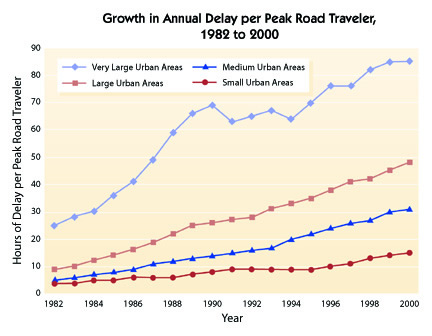
If you're feeling like car travel takes longer than ever, this chart from a U.S. Department of Transportation study on traffic congestion should validate your feelings. Growth of motor vehicles has far outstripped growth of roads, and traffic jams are the inevitable result. Lots of studies have measured the losses in terms of time, money, and pollution. So, aside from getting out of our cars, what are the options for reducing traffic congestion?

Wikipedia presents Anthony Downs' (author of Stuck in Traffic and Still Stuck in Traffic) view on the economics of the congestion problem here:
In a capitalist economy, goods can be allocated either by pricing (ability to pay) or by queueing (first-come first-serve); congestion is an example of the latter. Instead of the traffic engineer's solution of making a "pipe" large enough to accommodate the total demand for peak-hour vehicle travel (a supply-side solution), either by widening roadways or increasing "flow pressure" via automated highway systems, Downs advocates greater use of road pricing to reduce congestion (a demand-side solution, effectively rationing demand), in turn plowing the revenues generated therefrom into public transportation projects. Road pricing itself is controversial, more information is available in the dedicated article. - Wikipedia

Since the cost of building more roads in congested urban areas has become exorbitant (for lack of more space, Los Angeles has even considered double-decker freeways), the usually supply-sided White House agrees with Downs' assessment.
President Bush's fiscal 2008 budget proposal would fund pilot projects that encourage metropolitan areas to experiment with congestion charging as a way to reduce traffic. - Washington Post

One problem with tolling is the economic burden it places on poorer commuters, often the commuters with the longest commutes. However, tolling is the easiest solution today because current queuing technology in the form of metering lights fails to solve the congestion problem.

Why? Well, metering lights look at local traffic to determine how much traffic to allow on a highway. Metering lights fail to consider the accident 10 or 20 miles down the road, or the interchange that has started to back up. They merrily meter cars on to the highway, feeding the growing traffic jam until it engulfs traffic around the on ramp. By then, the damage has been done.

How much traffic fits on a highway?
The California Department of Transportation figures that the maximum capacity of a highway occurs at about 45 miles per hour and about 2,000 cars/hour/lane. - University of Washington

It turns out that automobile traffic networks break down in a way similar to the way Internet traffic breaks down. In both kinds of network, after the traffic surpasses the maximum sustainable flow, it slows way down and it takes some time to recover. The Internet's advantage, of course, is that it's much easier to re-route electrons than atoms. So, the Internet can heal itself by re-routing while the traffic jam lingers until road network demand drops.

To increase lane utilization, one solution is conversant cars that communicate and coordinate with one another. Another solution uses cars with built-in technology to drive themselves. One organization is trying to create a competition like the Ansari X Prize (for private space travel) to stimulate private solutions to traffic congestion. Here's a video that shows how such a system might work:

The problem with solutions built in to cars, though, is the time it takes to introduce such solutions into the market. The costs are prohibitive, too. If tolling seems bad, think about charging everyone $500 or $1,000 for a device that enables conversant or smart cars. Most of these systems require every car to carry the device for the desired traffic decongestion.

This explains why economist Downs proposes tolling to solve the congestion problem. Are we really stuck with tolling to fix the demand side of the traffic congestion problem?

A promising emerging idea is to mix and match tolling and queuing. In this scenario, a driver would check online or call a phone number to make a reservation for a trip. If drivers provide the start and end points of their travel, it is easy to meter traffic correctly because all the traffic patterns can be computed in advance. In the simplest sense, this scenario requires each driver to agree with all the other drivers about the best time to get on the highway and the best speed to drive. It's similar to airline pilots agreeing when to take off so they don't all arrive at, say, JFK airport at the same time. Waiting five minutes on the tarmac is safer, arguably faster, and certainly more fuel efficient than circling with 20 other aircraft waiting to land.

Queuing doesn't preclude tolling, though. In fact, such a system could use tolling to allow drivers to buy earlier reservations. The design of such a tolling system could give paying drivers faster access while delivering the non-paying driver to his or her destination more quickly net of traffic congestion. In other words, the economical traveler would arrive sooner with this system than without this system, even though some drivers are paying for priority reservations. Tolls would pay the cost of deploying such a system. In the long-run, tolls would reduce tax burdens and provide additional funding for road maintenance.

The drawback? Drivers may have to wait to get on a highway. The benefits? Most drivers reach most destinations much more quickly. The costs? Net of tolls, the system can pay for itself.

The queuing/tolling solution has two important side-effects. First, you can fix the supply side problem. By measuring traffic flows through a network, the trip data tell you exactly where to add capacity cost effectively. Since congestion in California probably accounts for something like 1-2% of the state's total CO2 emissions, the second side effect is that this queuing/tolling system reduces greenhouse gases significantly.

My prediction is that you'll see a queuing/tolling system on urban highways in fewer than five years. There isn't any other good solution to congestion.

Labels: , , , , , , , ,

Tuesday, February 27, 2007

Sustainable Architecture

I took a walk around the new Federal building with my friend Jim, an architectural critic. If you walk around San Francisco, you can't miss the enormity of the City's most recent edifice.

However, you might miss some of the environmental features of the building. Most prominent of the features: no air conditioning. What may be most notable about the absence of air conditioning at the new Federal Building is that it took so long to build a modern office building without air conditioning in a city known for its natural air conditioning system: fog.

To replace air conditioning, the building employees several emerging technologies. Many windows open automatically to cool off the building, especially at night. On the north side of the building (see photo), the decorative fins act as chimneys to vent hot air up the side of the building. The delicate building skirt on the south side provides a sunblock that reduces radiation absorption on the building's sunniest surface.

Removing the air conditioning also frees up space inside the building. Gone are the air conditioning machines, electrical panels, and ducts needed to cool most modern office buildings. Building maintenance costs change, too, with automatic window maintenance replacing air conditioning maintenance. Removing the air conditioning also requires more attention to building orientation, with as narrow a building as possible for natural air flow and lighting, and as little eastern and western exposure as possible for sun utilization.

Some of the energy saving features involve behavior modification of the building's occupants. The elevators, for instance, stop at every third floor rather than at every floor. In theory, these elevators deliver you to your desired floor more quickly when you take an elevator that goes to your desired floor because that elevator makes fewer stops on the way. Fewer elevator stops translates into more efficient use of elevator energy. It also gives occupants an incentive to use stairs to travel to floors only one or two levels away.

All-in-all, the building's designers estimate the building will use 50% less energy than a standard U.S. office building. Here's a comprehensive video on how the EPA built a sustainable building. It examines everything from site utilization to construction techniques to energy use.

It's difficult to pinpoint the start of modern architecture, but William LeBaron Jenney's innovate use of steel framing made possible the first skyscraper in 1885. By today's standards, the 10-story Home Insurance Building appears minuscule.

When it was introduced, the clear advantage of skyscraper design was building more office space on a given plot of land. Since 1885, improvements in design, construction, material, and building technologies have provided the ability to build practically any office building imaginable. While architects cram more and more usable space onto a property with all these new technologies, they have not created particularly efficient buildings.

Given the economic advantages of building sustainable buildings, how did the commercial real estate market arrive at a point where sustainability is so rarely incorporated in building design? An emerging idea is that financial markets under-value total cost of ownership for a structure. Three factors cause the market to discount ongoing operating costs.

First, since buildings are easily razed and replaced, investors sometimes value a property for its potential cash flow rather than its current cash flow. As the expected life time for a building shrinks, so does the value of reducing a building's energy use.

Second, the risk of introducing a new sustainable technology may outweigh its potential cost savings. For example, if you build a commercial building with elevators that stop at every third floor, do you decrease the building's yield because fewer companies want to rent in the building? Give an investor a choice between a known design that creates a predictable cash flow and a new design that may save money, and the investor will chose the predictable cash flow every time.

Third, the increased liquidity of commercial real estate in today's capital markets gives builders an incentive to complete a building quickly with technology that its subcontractors have deployed rather than new technology that may slow down a project. Faster construction translates into quicker sales and lower construction financing costs. Liquidity increases with commoditization, too, and so an innovative building may take longer to sell.

What pushes the commercial real estate market towards sustainable building? Many of the sustainable buildings in the U.S. are government buildings. Since the government, a very large owner of office space, maintains buildings for long periods of time, it discounts sustainability differently than the commercial market and places a higher value lower operating costs. The good news is that taxpayers will be rewarded for the government's rational risk-taking. The better news is that the commercial markets will be able to model innovative sustainability technology accurately, thus reducing the risk of these technologies in the commercial market.

Other emerging ideas include better sustainability standards and different finance instruments. One simple sustainability standard would be a measure of energy use per usable area, analogous to the government's MPG mileage standards for cars. If buildings were rated for typical energy use in, say, BTUs per square meter, a tenant could compare office space with some idea how much of rent goes to pay the power company instead of building amenities. Such an energy use standard might have all the same problems as the MPG used for cars, but it has the potential to improve significantly the information flow in the real estate market.

Building financing could be split between short-, medium-, and long-term owners. Short-term owners would assume "start-up" risk, including design approval, project management of the construction, and commodity prices for materials. Long-term owners would assume "market" risks, including changes in local business activity, interest rates, and energy and labor costs. By segregating the risks, rewards could be tailored for categories of investors. As importantly, long-term owners would weigh-in on sustainability.

Unfortunately, plenty of inefficient buildings will stand with us for decades. That should give government and commercial building owners who care about sustainable architecture more incentive to fix the market soon.


Update: Jim's take on the new San Francisco Federal Building.

Labels: , , , ,